CH 01
TV and studio interviews
Short slots, bright lights and a host on a clock. You learn to get one clear message in, in plain words, the first time you're asked.
Home / Media training in Dubai
TV · Podcasts · Panels · Press
The red light comes on, the host asks the first question, and your head goes blank. Or you talk for three minutes and they use none of it. Josh trains founders, leaders and experts in Dubai to show up on camera, on the mic and on panels with one clear message and a calm voice.
Where it shows up
A TV studio, a podcast and a panel all look like "talking". They ask different things of you. Media training with Josh starts with the format you're actually facing, then works back from there.
Short slots, bright lights and a host on a clock. You learn to get one clear message in, in plain words, the first time you're asked.
Long form. You have time, and that's the trap, because people ramble. You learn to tell stories with a shape so listeners stay with you.
You share the stage and the clock. You learn to answer short, build on what others said, and still be the one people remember.
Quotes get cut and radio has no face to help you. Every line has to stand on its own, so you practise lines that still make sense when they're clipped.
A launch video, a company message, content for social. No audience to feed off, only a lens. You learn to bring the energy anyway.
The answer shape
Do you know what Josh noticed with people on camera? They either say too little and sound nervous, or say too much and the point gets lost somewhere in minute two. Both come from the same place: no shape.
So every answer gets one. It's the same shape Josh teaches for panel questions, and it works for a TV host, a podcast host or a journalist on the phone. Answer, one story, why it matters, tie it back. Then stop.
Stories are sticky, facts are forgettable. On air that matters even more, because most people only hear you once. One real moment, told well, does more than ten statistics read off a card.
00:00Straight away, in one line. No warm-up, no "that's a great question".
00:05One moment, one person, one place. Take them into the room. The more real it is, the more people trust it.
00:20"The reason I share this with you is because..." That's the line that turns a story into a point.
00:25Link it to what they asked, then close your mouth. A pause feels long to you. On the recording it sounds calm.
Message first
Before any interview, Josh gets you to write down one message and three keys. It's the same single page he gives every speaker. The message is the sentence you want people to repeat afterwards. The three keys are the points that back it up, each with a story you can tell in under a minute.
Then you practise getting back to them. A host will take the conversation wherever they like, and that's their job. Your job is to answer what they asked, properly and briefly, then link it to one of your keys. Done well, it sounds like a good conversation. Done badly, it sounds like dodging, so you practise until it sounds like you.
You also prepare for the question you don't want. Every guest has one. You say it out loud in the session, more than once, so the first time you hear it isn't on air.
Studio notes
Your message is half of it. The other half is how you sound and look while you say it. These are the notes that come up again and again in Josh's sessions.
A camera is a room of one person, sitting very close. You bring the volume down a touch and keep the energy in your face and voice.
Talking with a host, you look at the host. Talking to camera, the lens is the person. You practise both so you always know which one you're in.
Count two seconds in your head. It feels endless to you and sounds sure of itself on the recording.
The first note Josh's own mentor gave him: "Hey, Joshi, can you smile when you speak?" On camera, people read your face before they hear a word.
Neutral, power and soft. One tone for a whole interview turns into background noise. Anything that becomes default becomes boring.
Watch it back with the sound off first, then listen with the screen down. You'll see and hear things you'd never notice live.
Who's training you
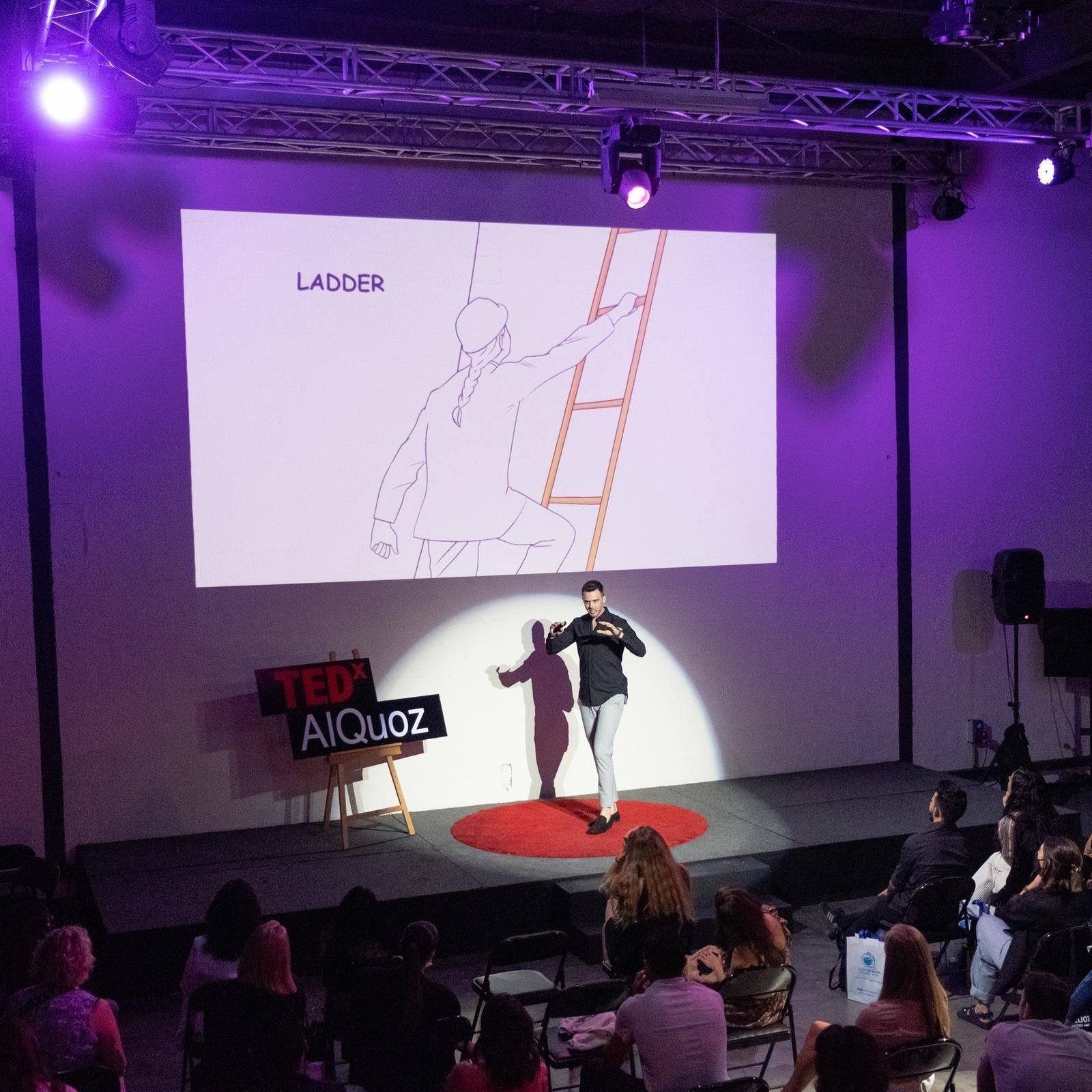
Josh is a two-time TEDx speaker and a founders pitching mentor on the Game Changers Middle East TV show. Before he ever taught speaking, he spent about ten years on stage as a professional musician. So he knows what the lights, the countdown and the silence before you start feel like.
He also knows what it's like to be the nervous one. He was the bullied kid they called Train Tracks, and speaking was his biggest fear before it became his job. Public speaking is a skill, and skills can be trained. Speaking on camera is the same skill with a lens in the room.
Trained with, spoken for, featured on
In their words
"WOW!"
I used to hate the way my voice sounds and I'd panic in front of people. Now I've been able to embrace it, improve it, and learn storytelling, vocal strategies and speaking structure. Future and present me is so grateful.
"Much more confident on stage"
It feels so much more natural, like second nature now. Don't say what if, just do it.
Who it's for
FAQ
Something not covered? Ask Josh on WhatsApp.
Practice for being interviewed or filmed: TV, podcasts, radio, press and panels. You work on your message, the shape of your answers and how you come across on camera, using mock interviews that feel close to the real thing.
They're different jobs. Media training is for interviews an audience sees or hears. Job, promotion and panel interviews for a role have a different goal, and Josh covers those on the interview coaching page.
A date in the diary is the best reason to start. Book the 20-minute call, share the show, the host and the topic, and Josh will tell you what he'd focus on first with the time you have.
Yes, that's the point of them. You record, watch it back with the sound off, listen with the screen down, then go again with one note. Record and review is where most of the change happens.
Tell him on the call how many people need to be ready and for what, and he'll suggest a format. If the whole team needs general speaking skills, see corporate public speaking training.
It depends on what's coming up and how many sessions you need. There's no price on this page. Book the call or message Josh on WhatsApp and he'll tell you what he'd recommend.
20 minutes · no pressure
Twenty minutes. Tell Josh the show, the panel or the shoot, and when it is. He'll tell you what he'd fix first.
Corporate or event enquiry? Email [email protected] with your dates.
Related