You stay quiet
The idea is clear in your head. By the time you find a gap, the conversation has moved, so you tell yourself you'll raise it later. Later rarely comes.
Home / How to speak up in meetings in Dubai
You had the point. You waited for a gap. The meeting moved on. Or you finally spoke, and it came out long, and someone cut in. Josh coaches people in Dubai who stay quiet, freeze, ramble or get talked over in meetings, video calls and rooms with senior people.
Today's table
The work is to get your name off the silent list and into the minutes, clearly, once, without taking over the room.
What gets in the way
The idea is clear in your head. By the time you find a gap, the conversation has moved, so you tell yourself you'll raise it later. Later rarely comes.
Someone turns to you. Your mind goes blank. You hear yourself say "um" or "sorry, what was the question?" and the moment is gone.
You start at the beginning, add context, add more context, and the point arrives three minutes late, if it arrives at all. People stop tracking.
You begin, someone louder comes in, and you let it go. The room hears the other version. You leave annoyed with yourself, and with them.
The shape of a comment
Good speakers follow structure. In a meeting that structure is short. You practise it until you can do it even when your heart is going.
A simple way in: "One point on that," or "Can I add something?" You hold the space, take a breath, and start. Don't wait for a perfect gap that never comes.
Lead with the point, not the background. If they only hear the first sentence, they should still know what you think.
One example, one number you actually have, one short story. Then stop adding. Point, evidence, close. That's enough.
If you need a decision, ask for it. If you don't, stop talking. A two-second pause at the end sounds sure of itself. "Um, yeah, so..." does not.

The rooms it shows up in
Speak for the size of the room that you're in. A stand-up of four people is not a town hall. The point stays short in both.
Unmute, look at the camera, and go shorter than you think. There's no body in the room to help you, so the headline has to do more work.
They asked for a recommendation, not a tour of your research. One clear view, one reason, then you can take questions.
Come back in once, calmly: "I still have one point on that." You can win conversations but lose the connection if you fight for airtime. Come back clear, and stay calm.
Josh works with a lot of people in Dubai in this position. Simplify. Short words, one point, a downward tone so it sounds like an answer, not a question.
How it runs
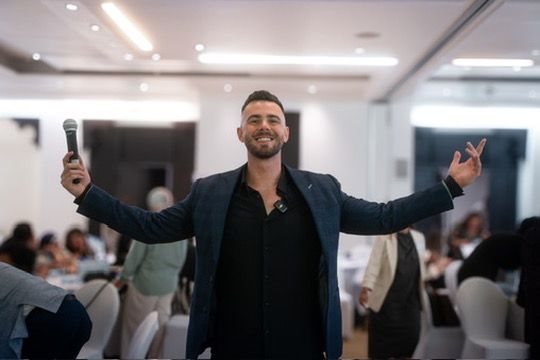
Josh doesn't believe in theory courses. You bring a real meeting: the update you keep rushing, the question you froze on, the room that talks over you. Then you do it, get one note, and go again.
Which page fits
If the main issue is stage fright, see how to overcome fear of public speaking. If the job is to be believed in a boardroom, see executive presence coaching.
In their words
"I wish I had started this sooner"
I avoided public speaking for years because I was afraid I wasn't capable, or worried I'd embarrass myself. Now I wish I had started sooner. It would have accelerated my progress and boosted my confidence much earlier.
"Much more confident on stage"
It feels so much more natural, like second nature now. Don't say what if, just do it.
FAQ
Something not covered? Ask Josh on WhatsApp.
How to get a point into a meeting clearly and briefly: signalling you have something to add, leading with the headline, giving one piece of evidence, then stopping. You also practise video calls, rooms with senior people, and what to do when someone talks over you.
No. This page is for people who stay quiet, freeze, ramble or get talked over in meetings. Communication coaching is the wider workplace skill, including presentations and client conversations. Leadership communication training is for managers speaking to the teams they lead.
That's common in the rooms Josh coaches in Dubai. The work is to simplify: a short headline, one example, then stop. You don't need bigger words. You need a point the room can hear the first time.
Yes. If a team keeps leaving meetings with the same two people talking, tell Josh on the call how many people and what those meetings look like, and he'll suggest a format. A speaking-based team building workshop can also get everyone on their feet in one session.
Yes. You practise the pause, a one-line answer, and one example, using the kind of question you actually get asked. Nerves usually still show up a little, because you care. You learn how to manage them so the point still comes out.
It depends on whether you're working one-to-one or as a team, and what's coming up. There's no price on this page. Book the call or message Josh on WhatsApp and he'll tell you what he'd recommend.
20 minutes · no pressure
Twenty minutes. Tell Josh the room, what usually happens, and what you want to be able to say. He'll tell you what he'd work on first.
Corporate or event enquiry? Email [email protected] with your dates.
Related